As you prepare for the future of fleet management, understanding the best vehicle telemetry systems of 2026 is essential. With advancements in technology, you’ll find options that enhance operational efficiency and communication. From the Spektrum AR8360T+ to the FrSky TANDEM X20 PRO, each system offers unique features tailored to meet your needs. Curious about how these systems compare? Let’s explore the top picks and factors to evaluate.
Spektrum AR8360T+ 8 Channel AS3X+ & Safe Telemetry Receiver, SPM-1033

The Spektrum AR8360T+ 8 Channel AS3X+ & Safe Telemetry Receiver, SPM-1033 is ideal for hobbyists and model pilots seeking advanced flight stability and telemetry data without the hassle of additional sensors. It’s compatible with all Spektrum DSM2 and DSMX transmitters, making it versatile for your needs. The built-in AS3X+ stabilization system guarantees smooth flights, while SAFE flight envelope protection keeps your model safe. Enjoy full telemetry capabilities, including altitude and vario data, thanks to the integrated barometer. Its compact footprint suits various models, from parkflyers to giant scales, making it a perfect choice for your fleet management endeavors.
Best For: Hobbyists and model pilots looking for advanced flight stability and telemetry data in their RC models.
Pros:
- Built-in AS3X+ stabilization system ensures smooth and stable flights.
- Full telemetry capabilities with no additional sensors required, providing altitude and vario data.
- Compact footprint makes it compatible with a wide range of model sizes, from parkflyers to giant scale.
Cons:
- Limited to Spektrum transmitters, which may restrict compatibility with other brands.
- May require a learning curve for users unfamiliar with AS3X+ and SAFE systems.
- Higher price point compared to basic receivers without telemetry features.
Futaba 3PV Three-Channel Radio Control Transmitter with R304SB Receiver

For those seeking precision and real-time data in their fleet management, the Futaba 3PV Three-Channel Radio Control Transmitter with R304SB Receiver stands out with its advanced telemetry capabilities. Utilizing FHSS, S-FHSS, and T-FHSS protocols, it guarantees reliable communication. The R304SB receiver supports telemetry sensors, giving you real-time updates on voltage, enhancing your operational insights. With a large screen and intuitive menu, accessing information is simple. Digital trims for steering and throttle are conveniently placed for quick adjustments, allowing for precise control. Plus, the transmitter accommodates various battery types, assuring you’re always powered up and ready to go.
Best For: The Futaba 3PV is best for hobbyists and professionals looking for a reliable and precise radio control system for their surface vehicles.
Pros:
- Advanced telemetry capabilities provide real-time updates on voltage, enhancing operational insights.
- User-friendly interface with a large screen and intuitive menu for easy access to information.
- Convenient digital trims positioned for quick adjustments, allowing for precise control of steering and throttle.
Cons:
- Batteries not included, requiring an additional purchase for operation.
- Limited to three channels, which may not be sufficient for more complex setups.
- May require a learning curve for users unfamiliar with telemetry systems and advanced settings.
Traxxas 6553X Telemetry Expander 2.0 and GPS Module 2.0, TQi Tadio System

Releasing the potential of your fleet management, the Traxxas 6553X Telemetry Expander 2.0 and GPS Module 2.0 integrates seamlessly with the TQi Radio System. This compact system measures 4.3 x 8.2 x 1.8 inches and weighs just 3.2 ounces, making it easy to install. With an impressive average rating of 4.4 stars from 252 reviews, it’s a trusted choice among users. Designed for ages 8 months and up, the product offers competitive pricing and warranty details upon request. You can even report lower prices to guarantee you get the best deal for your telemetry needs.
Best For: The Traxxas 6553X Telemetry Expander 2.0 and GPS Module 2.0 is best for RC enthusiasts looking to enhance their fleet management and telemetry capabilities.
Pros:
- Seamless integration with the TQi Radio System for easy setup.
- Compact and lightweight design allows for simple installation on various RC models.
- High customer satisfaction with an average rating of 4.4 stars from 252 reviews.
Cons:
- Warranty information is only available upon request, which may be inconvenient for some customers.
- Age recommendation may limit use for younger enthusiasts, as it’s designed for ages 8 months and up.
- Price reporting system requires additional effort from users to ensure competitive pricing.
RFD900X-US Telemetry Bundle
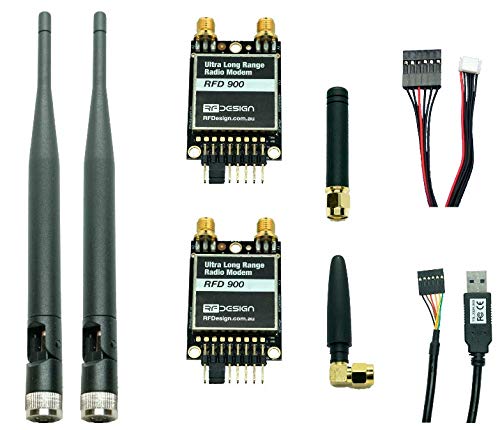
Designed specifically for fleet managers seeking reliable data communication, the RFD900X-US Telemetry Bundle stands out with its dual telemetry modems equipped with encryption and PPM passthrough. This bundle includes two RFD900x modems, two dipole antennas, two monopole antennas, a USB cable, and a Pixhawk cable, all housed in a custom carbon fiber case for durability. With package dimensions of 9.8 x 3.4 x 2.4 inches and weighing just 8.8 ounces, it’s both portable and efficient. Customers rate it an impressive 4.2 out of 5 stars, making it a solid choice for your fleet management needs.
Best For: Fleet managers seeking reliable and secure data communication solutions.
Pros:
- High-quality encryption ensures secure data transmission.
- Compact and lightweight design makes it easily portable for field use.
- Includes multiple antenna options for flexible setup and improved signal strength.
Cons:
- Requires technical knowledge for optimal setup and configuration.
- Limited warranty information may concern some buyers.
- Average customer rating suggests mixed user experiences.
Radiomaster MT12 Edgetx Open-Source Radio Controller for RC Vehicles

The Radiomaster MT12 Edgetx Open-Source Radio Controller excels for hobbyists seeking reliable control over their RC vehicles, including cars and boats. With its 2.4G 4-in-1 multi-protocol setup, you’ll enjoy seamless compatibility with various brands. The included R85C receiver and universal frequency support provide flexibility for all your RC needs. Operating on a DC 4.5–8.4V power supply, it accommodates different battery types like LiPo and NiMH. Plus, its lightweight design and 5CH PWM output provide precise control for maximum performance. Experience strong, interference-free signals and reliable telemetry power for long-range enjoyment with your RC adventures.
Best For: Hobbyists seeking a versatile and reliable control solution for their RC vehicles, including cars and boats.
Pros:
- Seamless compatibility with various brands due to its 4-in-1 multi-protocol setup.
- Lightweight design at just 5.7 grams, enhancing ease of use and portability.
- Strong and interference-free signals thanks to the high-sensitivity antenna, ensuring reliable long-range performance.
Cons:
- Limited to 2.4GHz frequency, which may not suit all specialized RC setups.
- Requires external power supply (DC 4.5–8.4V), which may necessitate additional battery management.
- May lack advanced features found in higher-end models, potentially limiting some professional users.
Spektrum FC6350HX Helicopter Flybarless Control System, SPMFC6350HX

For helicopter enthusiasts seeking precise stability and control, the Spektrum FC6350HX Flybarless Control System stands out with its user-configurable SAFE Panic Recovery feature. This model, SPMFC6350HX, supports two DSMX remote receivers, ensuring reliable communication. You’ll appreciate its Stability Flight Modes, which enhance your flying experience. The easy-to-use Forward Programming simplifies setup and gain adjustments, making it user-friendly. Plus, it’s compatible with Spektrum transmitters from the DX, iX, and NX series. With Smart Technology integration, you can easily connect Smart ESCs and Smart Battery telemetry, providing you with real-time performance insights that elevate your flying skills.
Best For: Helicopter enthusiasts seeking enhanced stability and control in their flying experience.
Pros:
- User-configurable SAFE Panic Recovery feature provides added safety for novice pilots.
- Easy Forward Programming allows for straightforward setup and gain adjustments.
- Compatibility with Spektrum transmitters ensures a versatile flying experience with reliable communication.
Cons:
- Limited to Spektrum transmitter compatibility, which may restrict options for some users.
- Requires two DSMX remote receivers for optimal performance, which may add to the overall cost.
- May have a steeper learning curve for beginners unfamiliar with flybarless systems.
Spektrum AR20410T 20-Channel PowerSafe Telemetry Receiver, SPMAR20410T
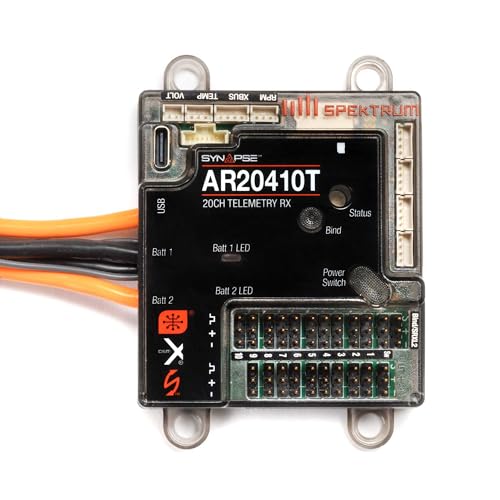
When you need a reliable telemetry solution for power-hungry aircraft and high-current servo applications, the Spektrum AR20410T 20-Channel PowerSafe Telemetry Receiver stands out. Its patented PowerSafe redundancy system guarantees safety with dual battery input ports and IC3 connectors, supporting current draws up to 35A and a max burst of 50A. You’ll appreciate the innovative power management system, which includes a sleep mode for remote power control from your transmitter. Plus, the intuitive forward programming guides you through setup easily, eliminating the hassle of memorizing complex maneuvers. Don’t forget the USB-C port for effortless updates and registration.
Best For: The Spektrum AR20410T is best for enthusiasts and professionals looking for a reliable telemetry solution in power-hungry aircraft and high-current servo applications.
Pros:
- Patented PowerSafe redundancy system ensures safety with dual battery input ports.
- Innovative power management system allows for remote power on/off control from the transmitter.
- Intuitive forward programming simplifies setup with step-by-step guidance.
Cons:
- Higher price point compared to standard receivers may not be suitable for budget-conscious users.
- Compatibility limited to specific flight stabilization modules, which could restrict options for some users.
- Complexity in features may overwhelm beginners unfamiliar with telemetry systems.
REC Telemetry 915 mHz for APM Pixhawk Flight Controller

Designed specifically for APM Pixhawk flight controllers, the REC Telemetry 915 mHz system stands out as an ideal choice for drone enthusiasts and fleet managers seeking reliable communication. It features a compact, lightweight design with detachable antennas, making transportation and setup a breeze. You’ll appreciate the USB and analog interfaces that allow seamless integration with various devices. With robust build quality, this system promises stable operation and lasting durability. Plus, its plug-and-play setup requires no additional software, ensuring compatibility with multiple operating systems and applications. Experience hassle-free telemetry that enhances your fleet management capabilities effortlessly.
Best For: Drone enthusiasts and fleet managers seeking reliable and efficient communication solutions for APM Pixhawk flight controllers.
Pros:
- Compact and lightweight design facilitates easy transportation and setup.
- Robust build quality ensures stable operation and long-lasting durability.
- Plug-and-play setup requires no additional software, compatible with multiple operating systems.
Cons:
- Limited to 915 mHz frequency, which may not be suitable for all regions.
- Detachable antennas may be prone to loss if not stored properly.
- Integration with certain specialized devices may require additional configuration.
FrSky TANDEM X20 PRO AW Drone with 24-Channel Remote Control

The FrSky TANDEM X20 PRO AW Drone, equipped with a 24-channel remote control, stands out as an ideal choice for professionals seeking advanced vehicle telemetry systems for fleet management. With its high-precision gimbal and long-range telemetry, you’ll experience unmatched reliability in communication. The drone features a bright touchscreen display and advanced functionalities like haptic feedback and text-to-speech, enhancing your operational efficiency. Plus, its USB Type-C charging system makes recharging effortless. The precision Hall-sensor gimbals guarantee smooth maneuvers, while the 8GB flash storage provides ample data capacity for your monitoring needs. This drone is truly a game-changer for effective fleet management.
Best For: Professionals and businesses in need of advanced telemetry systems for efficient fleet management.
Pros:
- High-precision gimbal ensures smooth and accurate control during flight.
- Long-range telemetry and reliable communication enhance operational efficiency.
- User-friendly interface with bright touchscreen and advanced features like haptic feedback and text-to-speech.
Cons:
- The advanced features may have a learning curve for new users.
- Limited battery life may require frequent recharging during extended operations.
- Higher price point compared to basic drones may not be suitable for casual users.
HOBBYWING S.BUS2 Telemetry Adapter for FUTABA Radio System

For hobbyists and enthusiasts using HOBBYWING electronic speed controllers (ESCs) with Futaba radio systems, the HOBBYWING S.BUS2 Telemetry Adapter offers a seamless connection that enhances performance monitoring. This adapter is compatible with Platinum V4/4.1/5 series ESCs, allowing you to connect your electronic governor directly to your Futaba receiver. Supporting the S.BUS2 protocol, it enables real-time telemetry data transmission, displaying essential performance metrics right on your Futaba radio. If you’re looking to optimize your setup and gain insights into your model’s performance, this telemetry adapter is a must-have accessory for your HOBBYWING and Futaba system combination.
Best For: Hobbyists and enthusiasts using HOBBYWING ESCs with Futaba radio systems seeking enhanced performance monitoring.
Pros:
- Seamless integration with Platinum V4/4.1/5 series ESCs for direct connection to Futaba receivers.
- Real-time telemetry data transmission allows for immediate performance insights.
- User-friendly display of essential metrics directly on the Futaba radio enhances monitoring capabilities.
Cons:
- Limited compatibility only with Futaba receivers that support S.BUS2 protocol.
- Potential learning curve for users unfamiliar with telemetry systems.
- Dependency on specific ESC models, which may not suit all setups.
Factors to Consider When Choosing a Vehicle Telemetry System
When you’re choosing a vehicle telemetry system, several factors can make or break your decision. You’ll want to evaluate compatibility with your existing systems, the data transmission range, and how well it integrates with sensors. Additionally, think about the user interface design and power supply options that best fit your fleet’s needs.
Compatibility With Existing Systems
Choosing the right vehicle telemetry system hinges on its compatibility with your existing infrastructure. Confirm that the system works with your current transmitter protocols, like DSM2, DSMX, T-FHSS, or S-BUS2, for seamless integration. Check if it’s compatible with the receivers you already have, as some systems may only support specific models or brands. Opt for systems that offer multi-protocol support to boost flexibility across various vehicles. Additionally, verify that the telemetry system can communicate with your existing flight control or electronic speed control units, especially if they require specific protocols for data transmission. Finally, look for options that provide easy setup and configuration, minimizing the need for additional software or complex programming steps.
Data Transmission Range
Understanding data transmission range is crucial for effective vehicle telemetry systems, as it can vary from a few hundred meters to several kilometers. When choosing a system, consider the technology and frequency used; higher frequency bands like 2.4GHz may offer longer ranges but can be more prone to interference. Look for systems that employ advanced modulation techniques to boost range and reliability, guaranteeing clearer communication over distances. Remember, line of sight is critical—obstacles like buildings and trees can greatly diminish range. Additionally, environmental factors such as weather and terrain can impact performance, so testing your system in different conditions is essential to guarantee it meets your fleet management needs effectively.
Sensor Integration Capabilities
Effective fleet management relies not only on reliable data transmission but also on the integration of various sensors that enhance vehicle telemetry systems. When choosing a system, consider its compatibility with essential sensors like GPS, barometers, and voltage monitors. These integrations provide extensive insights into vehicle performance and the surrounding environment. Look for systems that support multiple telemetry protocols, such as S.BUS2 or T-FHSS, to guarantee flexibility in connecting various devices. Real-time data transmission is vital for immediate adjustments, while plug-and-play integration simplifies setup, saving you time. Additionally, built-in features like altitude tracking and battery voltage monitoring can streamline your telemetry experience, reducing the need for external equipment and enhancing overall efficiency.
User Interface Design
A well-designed user interface is essential for maximizing the effectiveness of vehicle telemetry systems. You’ll want a user-friendly interface with intuitive menus and clear displays to easily navigate telemetry data and settings. Large, high-resolution screens enhance visibility, especially in outdoor conditions. Make sure the arrangement of control functions, like digital trims and adjustments, is conveniently positioned for quick access, enabling precise control during operation. Customization options within the user interface can boost your engagement, allowing you to tailor layouts and displayed information to fit your preferences. Additionally, look for feedback mechanisms such as haptic alerts or voice outputs, as they provide immediate notifications about telemetry data, improving your situational awareness while using the system.
Power Supply Options
Selecting the right power supply options for your vehicle telemetry system can greatly impact its performance and reliability. First, check the power supply compatibility, as systems typically require voltage levels between 4.5V and 8.4V. Look for systems that support various power types, like LiPo, NiMH, or alkaline batteries, ensuring versatility. Evaluate the current draw specifications, especially if you have power-hungry applications that may need up to 35A. Consider systems with patented redundancy features, such as dual battery input ports, to maintain operation if one source fails. Finally, opt for telemetry options that offer power management features, including sleep modes, allowing you to conserve battery life with remote power on/off capabilities.
Setup and Configuration Ease
When choosing a vehicle telemetry system, ease of setup and configuration can greatly influence your experience. Look for systems that offer intuitive forward programming, providing step-by-step guidance for adjustments. This feature simplifies the setup process considerably. Choose solutions that require minimal software installation, allowing for plug-and-play connectivity with various devices and operating systems. User-friendly interfaces, like large screens or intuitive menus, enhance your configuration and monitoring experience. Ascertain the telemetry receiver supports seamless integration with existing hardware, which reduces complexity and guarantees compatibility across different vehicles. Finally, consider systems with built-in telemetry capabilities, eliminating the need for extra sensors and streamlining the overall configuration process. This way, you’ll save time and effort while maximizing efficiency.