When it comes to ensuring your vehicle runs smoothly, having the right engine monitoring system can make all the difference. You want something that not only tracks essential metrics but also alerts you to potential issues before they escalate. With various options available, from user-friendly OBD II scanners to advanced diagnostic tools, it’s vital to know what features matter most. Let’s explore the top choices and find the perfect fit for your needs.
MERCURY Marine SmartCraft Connect Mobile Outboard Engine System

The MERCURY Marine SmartCraft Connect Mobile Outboard Engine System is ideal for boat owners who want seamless access to their engine’s performance data. With this system, you can easily track engine metrics and fuel efficiency right from your mobile device. By using the Mercury Marine app, you can monitor live data, access digital gauges, and manage maintenance schedules effectively. It’s designed for easy plug-and-play installation for single engines, while the Avator 7.5e requires dealer assistance. This connectivity not only enhances your boating experience but also guarantees you stay informed and prepared for any service needs, improving overall performance.
Best For: Boat owners seeking real-time engine performance monitoring and enhanced maintenance management through mobile connectivity.
Pros:
- Provides live engine data and fuel tracking for informed decision-making.
- Easy plug-and-play installation for single engines simplifies setup.
- Streamlines maintenance tracking and dealer connectivity for convenience.
Cons:
- Avator 7.5e installation requires professional dealer assistance, which may add to costs.
- Compatibility limited to Mercury and MerCruiser engines from 2004 and newer.
- Relies on mobile device connectivity, which may be affected by signal strength in remote areas.
ANCEL AD310 OBD II Scanner Car Engine Fault Code Reader

If you’re looking for a reliable and user-friendly tool to diagnose your vehicle’s check engine light, the ANCEL AD310 OBD II Scanner is an excellent choice. This compact scanner works with 1996 or newer OBD2 vehicles, offering features like reading and clearing diagnostic trouble codes, live data monitoring, and I/M readiness checks. With its sturdy design and clear display, you can quickly identify issues without hassle. Powered directly from the OBDII connector, it’s portable and easy to use. However, keep in mind it focuses mainly on emission-related problems and won’t read unrelated engine fault codes.
Best For: Those seeking an affordable and user-friendly OBD II scanner to diagnose check engine light issues in 1996 or newer vehicles.
Pros:
- Easily reads and clears diagnostic trouble codes.
- Compact and portable design for convenient use.
- Recommended by Scotty Kilmer, ensuring reliability in identifying check engine light causes.
Cons:
- Limited to diagnosing only emission-related issues.
- Not compatible with OBDI vehicles, even with adapters.
- Lacks advanced features found in more expensive scanners.
ScanGauge 3 Touch Screen OBD2 Code Reader

For car enthusiasts and everyday drivers alike, the ScanGauge 3 Touch Screen OBD2 Code Reader stands out with its vibrant capacitive touch display featuring 16 million colors. It’s compatible with all 1996 and newer vehicles, easily reading and clearing check engine light codes. You can monitor up to nine gauges simultaneously and customize your favorites across multiple pages. Plus, with free wireless updates via WiFi, staying current is a breeze. Visual and audible alerts keep you informed of any issues, while the responsive interface guarantees ease of use. This tool gives you peak performance and peace of mind on the road.
Best For: Car enthusiasts and everyday drivers looking for an advanced, user-friendly OBD2 code reader to monitor vehicle performance.
Pros:
- Capacitive touch display with 16 million colors for a vibrant user experience.
- Compatible with all 1996 and newer vehicles, ensuring wide-ranging usability.
- Free wireless updates via WiFi keep the device current with the latest features and fixes.
Cons:
- May be overkill for casual drivers who only need basic code reading functionality.
- The touch screen may not perform well in direct sunlight, affecting visibility.
- Some users may find the price point higher compared to basic OBD2 readers.
MH Obd2 Gauge Display Heads Up Display

Drivers who crave real-time insights into their vehicle’s performance will find the MH OBD2 Gauge Display Heads Up Display an invaluable tool. With its 4.3-inch TFT LCD screen, you’ll enjoy clear visibility even in bright sunlight. This display tracks over 20 key data points, including RPM and engine temperature, while its dual OBD and GPS system guarantees thorough monitoring. Customizable settings, intuitive touch controls, and support for multiple languages make it user-friendly. Plus, you can easily scan and clear fault codes, keeping your vehicle in prime shape. Experience peak performance and peace of mind with this essential device.
Best For: Drivers who seek real-time vehicle performance insights and diagnostics for enhanced driving experience.
Pros:
- User-friendly interface with intuitive touch controls and multi-language support.
- Comprehensive monitoring of over 20 key data points providing critical vehicle information.
- Customizable features including dynamic ambient lighting and adjustable alarm settings.
Cons:
- May require OBD2 compatibility which could limit use for older vehicles.
- GPS performance may vary in areas with poor satellite visibility.
- Initial setup may take some time for users unfamiliar with OBD systems.
DiabloSport 8200 Intune i3

The DiabloSport 8200 Intune i3 is an ideal choice for performance enthusiasts seeking an easy-to-use tuning solution for their vehicles. With its new “Easy Tune” mode, installation is a breeze. You’ll experience impressive performance gains, adding 20-30 rwhp on most V8 applications and 35-50 rwhp on factory turbocharged setups. Plus, you can customize your driving experience with firm and hard shift options for the Transmission Control Module (TCM), where applicable. Each performance program is dyno-tested, ensuring reliability and effectiveness. If you’re serious about optimizing your vehicle’s performance, the Intune i3 is definitely worth considering.
Best For: Performance enthusiasts looking for an easy-to-use tuning solution to enhance their vehicle’s power and responsiveness.
Pros:
- Easy installation with the new “Easy Tune” mode.
- Significant power gains of 20-30 rwhp for V8 applications and 35-50 rwhp for turbocharged setups.
- Customizable driving experience with multiple TCM options for shifting preferences.
Cons:
- Compatibility limitations may restrict use for certain vehicle models.
- Potential need for additional modifications to fully realize performance gains.
- Requires basic knowledge of tuning and vehicle performance for optimal use.
BlueDriver Bluetooth Pro OBDII Scan Tool for iPhone & Android

Engine enthusiasts and everyday car owners alike will appreciate the BlueDriver Bluetooth Pro OBDII Scan Tool for its unmatched diagnostic capabilities. This tool connects wirelessly to your smartphone, providing instant access to your vehicle’s health. With no subscription fees, you can diagnose over 7000 issues, including check engine, ABS, and airbag problems. The user-friendly app offers unlimited repair reports, real-time data, and step-by-step repair videos. Plus, you’ll benefit from 24/7 professional support whenever you need it. Just plug it into your OBDII port, and you’re ready to enhance your driving experience with confidence.
Best For: Engine enthusiasts and everyday car owners looking for an affordable and user-friendly diagnostic tool for their vehicles.
Pros:
- No subscription fees or hidden costs, making it budget-friendly.
- Provides access to over 7000 diagnostic trouble codes, including advanced features like ABS and airbag diagnostics.
- User-friendly app with unlimited repair reports and 24/7 professional support available.
Cons:
- May not support certain vehicle makes or models beyond 1996 gas vehicles.
- Requires a smartphone or tablet to fully utilize its features, limiting usage for those without compatible devices.
- Some users may find the initial setup process cumbersome if they’re not tech-savvy.
Head Up Display Car HUD P8 for 2008+ Cars

For car enthusiasts looking to enhance their driving experience, the Head Up Display Car HUD P8 is an excellent choice, especially for those with vehicles from 2008 and newer. This innovative HUD features a dual OBDII and GPS system, providing real-time data straight from your vehicle’s ECU. You can install it on the A-Pillar trim or dashboard, connecting easily to USB power. With eight display interfaces, you can monitor speed, RPM, voltage, and more. Plus, it’s CE, FCC, and RoHS certified, ensuring quality. With decent customer feedback, it’s a solid investment for improving your driving experience.
Best For: Car enthusiasts with 2008 and newer vehicles looking to enhance their driving experience with real-time data.
Pros:
- Dual OBDII and GPS system provides comprehensive vehicle data for improved monitoring.
- Versatile installation options allow for placement on either the A-Pillar trim or dashboard.
- Multiple display interfaces offer customization for tracking various driving metrics.
Cons:
- Customer rating of 3.9 out of 5 stars may indicate varying experiences among users.
- Installation may require time to lock onto satellite signals, potentially delaying initial use.
- Limited compatibility with vehicles older than 2008 may exclude a significant number of drivers.
MH Head Up Display for Car, OBD2+GPS Dual System

Looking to enhance your driving experience? The MH Head Up Display for Car combines OBD2 and GPS systems, providing real-time data like speed, fuel consumption, and engine temperature. You won’t need to look down at your instruments, reducing distractions. It scans for fault codes, letting you clear them with a simple button press. Compatible with OBD2 vehicles post-2008, it offers customizable alerts for speeding and engine performance. With ten interface options and adjustable brightness, you can tailor it to your preference. Install it on your dashboard or windshield for ideal visibility and safety on the road.
Best For: Drivers of OBD2 vehicles manufactured after 2008 who seek to enhance their driving experience with real-time data and safety features.
Pros:
- Provides real-time driving data, minimizing distractions by allowing drivers to keep their eyes on the road.
- Offers customizable alerts for critical metrics like speeding and engine performance, enhancing safety.
- Features dual system compatibility (OBD2 and GPS) and ten customizable interface options for personalized use.
Cons:
- Incompatible with diesel, hybrid electric vehicles, pickup trucks, RVs, modified cars, and certain brands like Jeep and Peugeot.
- Requires a compatible OBD2 vehicle, limiting the target audience.
- Installation may require adjustments depending on the chosen mounting location (dashboard or windshield).
Lufi XF OBD2 Gauge Display and Vehicle Electronic Instrument Cluster
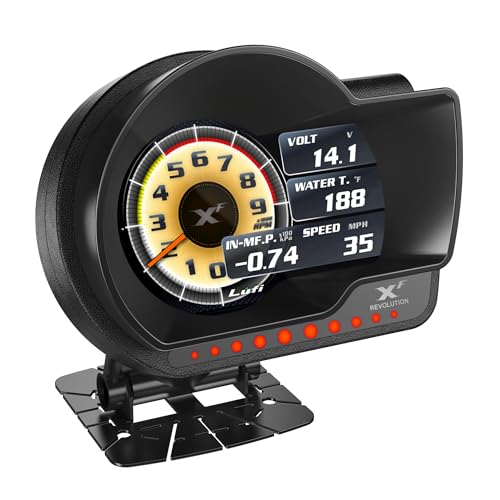
The Lufi XF OBD2 Gauge Display stands out as an important tool for performance enthusiasts who want to monitor their vehicle’s vital statistics in real-time. Compatible with many American, Japanese, and European cars, it connects easily to your vehicle’s OBD2 interface. This device tracks essential data like water temperature, boost pressure, and fuel consumption, ensuring you’re always informed. With visual and auditory alerts for critical thresholds, you won’t miss any important warnings. Plus, you can customize the display to suit your style. Just keep in mind it’s not for pure electric vehicles, and installation requires double-sided tape for secure mounting.
Best For: Performance enthusiasts wanting to monitor vital vehicle statistics in real-time.
Pros:
- Monitors essential data like water temperature, boost pressure, and fuel consumption.
- Provides visual and auditory alerts for critical thresholds to ensure safety.
- Customizable display options allow users to personalize their gauge setup.
Cons:
- Not suitable for pure electric vehicles.
- Compatibility may be limited for certain brands and may require custom PIDs for full functionality.
- Installation requires double-sided tape, lacking additional mounting options like suction cups.
KONNWEI KW206 Car OBD2 HUD Digital Meter Gauge
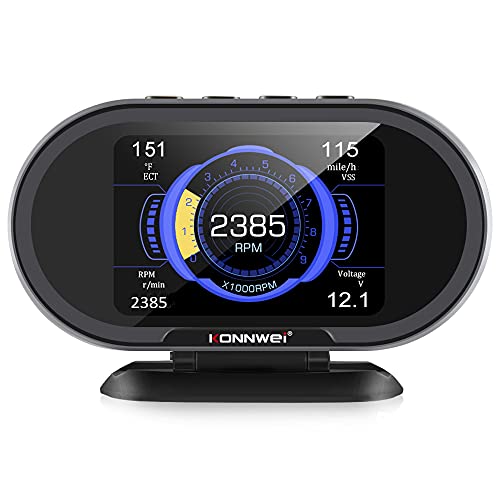
Engine monitoring systems like the KONNWEI KW206 Car OBD2 HUD Digital Meter Gauge are ideal for drivers who want real-time insights into their vehicle’s performance. This all-in-one automotive trip computer and diagnostic gauge is compatible with all 2003 and newer OBDII certified vehicles. Its 3.5-inch color LCD displays essential metrics like speed, RPM, and fuel consumption. With easy plug-and-play installation, you can effortlessly access live data and diagnostic features, including reading fault codes and turning off the check engine light. Plus, its safety alarms keep you informed, ensuring a smoother and safer driving experience.
Best For: Drivers seeking real-time vehicle performance insights and diagnostic capabilities in a user-friendly format.
Pros:
- Wide Compatibility: Works with all 2003 and newer OBDII certified vehicles, making it versatile for various car models.
- User-Friendly Interface: Easy plug-and-play installation and a straightforward 4-button operation enhance usability.
- Safety Features: Equipped with high update rates and warning systems to ensure a safer driving experience.
Cons:
- Size Limitations: The 3.5-inch display may be too small for some users who prefer larger screens for visibility.
- Limited Advanced Features: While it reads and erases DTCs, it may lack more advanced diagnostic capabilities found in higher-end models.
- Potential Learning Curve: New users may initially find the array of features overwhelming without adequate guidance.
Factors to Consider When Choosing an Engine Monitoring System
When choosing an engine monitoring system, you need to contemplate several key factors. Think about compatibility with your vehicle type, how easy it is to install, and whether it provides real-time data monitoring. Additionally, evaluate the user interface design and diagnostic capabilities to guarantee you get the most out of your system.
Compatibility With Vehicle Types
Choosing the right engine monitoring system means considering its compatibility with your vehicle type. First, confirm the system works with your vehicle’s OBDII protocol, especially if it’s from 1996 or later. Next, check if it supports your specific engine type—gas or diesel—since some systems cater to only one. You should also verify the device’s compatibility with your vehicle’s model year, as certain tools are designed for newer models, like those from 2008 onward. Additionally, consider whether the monitoring system supports multiple brands and models, as not all are universally compatible. Finally, if you own a hybrid or electric vehicle, be aware that some systems may need special configurations or might not function correctly at all.
Installation Complexity
After confirming compatibility with your vehicle, the next factor to evaluate is installation complexity. Some systems offer plug-and-play features for easy setup, while others may need professional installation for peak performance. If you’re looking at single-engine systems, they usually have simpler installation processes than those designed for multiple or specialized engines. Consider whether the system requires additional hardware, as this can complicate things. User manuals can help, but systems lacking clear instructions might increase your installation time and frustration. Finally, check if the manufacturer or dealer offers support, as having assistance during setup can simplify the process and make your experience smoother. Choose wisely to guarantee a hassle-free installation.
Real-Time Data Monitoring
Real-time data monitoring is essential for maximizing your engine’s performance, as it provides immediate insights into critical metrics like RPM, coolant temperature, and fuel consumption. With live data streaming, you can quickly identify engine faults or inefficiencies, preventing them from escalating into major issues. Advanced systems track over 20 key data points, including turbo pressure and driving mileage, giving you a thorough understanding of your vehicle’s dynamics. This effective monitoring can enhance fuel efficiency by informing you on how to optimize your driving behavior and engine operation. Additionally, many modern systems allow customizable alerts for critical parameters, ensuring you’re promptly notified of any abnormalities that could impact engine health or safety.
User Interface Design
When it comes to maximizing your engine’s performance, having the right user interface design in your monitoring system plays a significant role. You want a system that prioritizes clarity and ease of navigation, letting you quickly access essential engine data without unnecessary scrolling. Touchscreen interfaces can enhance your experience, but guarantee they have large buttons and clear labels to minimize distractions. Display readability matters too; choose high-contrast screens for visibility in varying lighting conditions. Customization options, like adjustable gauge layouts and color schemes, help tailor the display to your preferences. Finally, alerts and notifications should be distinct and easy to understand, using both visual and auditory signals to promptly inform you of critical engine issues.
Diagnostic Capabilities
Choosing the right engine monitoring system hinges on its diagnostic capabilities, as these features can greatly impact your ability to maintain vehicle health. First, you’ll want a system that reads and clears diagnostic trouble codes (DTCs) to quickly identify and resolve issues. Enhanced capabilities, like access to ABS and SRS systems, provide a thorough overview of your vehicle’s condition. Real-time data monitoring is essential; it lets you view live engine parameters, ensuring timely maintenance. Also, check for compatibility with various vehicle protocols and detailed fault information for accurate diagnostics. Finally, consider systems with visual and auditory alerts that notify you of critical parameters, enhancing safety by alerting you to potential issues before they escalate.