When it comes to maintaining your vehicle, having the right tools can make all the difference. Automotive fluid handling systems allow you to efficiently manage everything from oil changes to transmission fluid refills. With options available for both professionals and DIY enthusiasts, you’ll find systems that fit various needs and capacities. But which ones truly stand out? Let’s explore the top choices that promise to enhance your maintenance routine and performance.
Mityvac 7201 Fluid Evacuator Extractor and Dispensing Pump
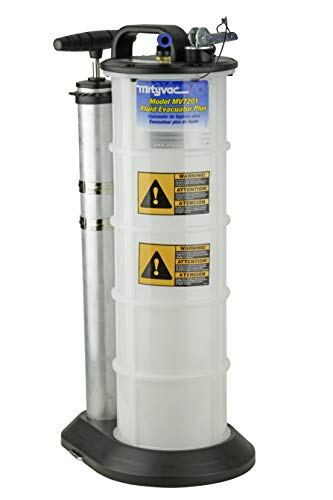
The Mityvac 7201 Fluid Evacuator Extractor and Dispensing Pump is your go-to solution if you’re looking for an efficient way to handle fluid changes in automotive and industrial settings. With a 2.3-gallon capacity, it effortlessly extracts and dispenses various fluids like oil and coolant. You’ll appreciate the push-button operation, giving you precise control while ensuring a smooth workflow. Its durable, chemical-resistant polyethylene construction means it’s built to last, and the automatic overflow prevention system keeps things tidy. Plus, its lightweight, compact design makes it portable, perfect for both professional mechanics and DIY enthusiasts tackling fluid maintenance tasks.
Best For: The Mityvac 7201 is best for professional mechanics and DIY enthusiasts looking for a reliable solution for fluid extraction and dispensing.
Pros:
- Efficient fluid extraction and dispensing with a simple push-button operation for easy control.
- Durable construction made from chemical-resistant polyethylene, suitable for various automotive fluids.
- Portable and compact design with a large base for stability, making it ideal for both workshop and on-the-go use.
Cons:
- Limited capacity of 2.3 gallons may not be sufficient for larger fluid changes or industrial applications.
- May require additional accessories for specific fluid types or applications, which are not included.
- Manual pumping effort may be needed to extract thicker fluids, potentially slowing down the process.
VEVOR Transmission Fluid Pump 2 Way ATF Refill System Dispenser
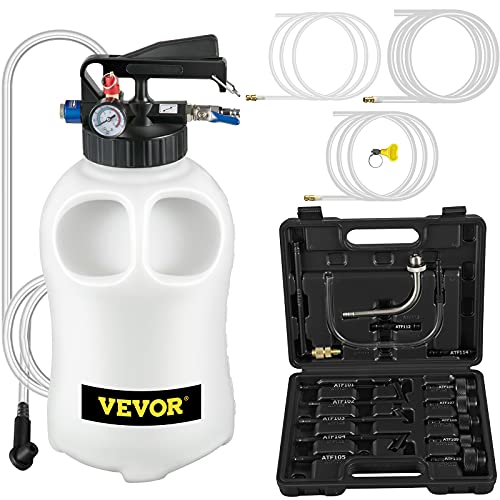
For automotive enthusiasts and professionals seeking a reliable fluid handling solution, the VEVOR Transmission Fluid Pump stands out with its impressive 10L capacity. This 2-way ATF refill system allows you to quickly and cleanly extract and dispense fluids, making oil changes a breeze. With 14 common adapters, it’s compatible with popular brands like BMW, Porsche, and Honda. The dual control system, featuring two-way valves, guarantees easy switching between extraction and dispensing. Plus, the built-in pressure gauge and overload protection enhance safety, while corrosion-resistant materials assure durability. You’ll appreciate the efficiency and convenience this pump brings to your maintenance routine.
Best For: Automotive enthusiasts and professionals looking for an efficient and reliable solution for fluid extraction and dispensing.
Pros:
- Large 10L capacity allows for efficient oil replacement in various vehicles.
- Includes 14 common adapters for compatibility with popular car brands like BMW, Porsche, and Honda.
- Equipped with safety features such as a pressure gauge and overload protection for enhanced reliability.
Cons:
- May be overkill for casual users who only perform occasional fluid changes.
- Requires some knowledge of automotive systems for proper use and setup.
- Initial investment may be higher compared to simpler fluid handling tools.
AIGMISON 3L Transmission Fluid Pump

Looking for a reliable solution to fill transmission fluid in your vehicle? The AIGMISON 3L Transmission Fluid Pump is your answer. This manual automotive oil filling system, patented under USD1063994S, allows you to easily and precisely pump various transmission fluids. Its sturdy construction guarantees durability, even under demanding conditions. You’ll appreciate the hand-operated pump, which provides a smooth and consistent flow rate for effective operation. Plus, its lightweight and compact design make storage and transportation a breeze. With the AIGMISON pump, maintaining your vehicle’s performance becomes effortless and efficient. Get ready to elevate your automotive maintenance game!
Best For: DIY automotive enthusiasts and mechanics looking for a reliable and efficient way to fill transmission fluid in vehicles.
Pros:
- Durable Construction: Made from sturdy materials that can withstand demanding automotive maintenance tasks.
- Smooth Operation: Hand-operated pump provides a consistent flow rate for precise fluid delivery.
- Portable Design: Lightweight and compact, making it easy to store and transport.
Cons:
- Manual Operation: Requires physical effort to pump, which may not be ideal for all users.
- Limited Capacity: At 3L, it may not be sufficient for larger vehicles or multiple fluid changes without refilling.
- Potential for Spillage: As a manual pump, there is a risk of spills if not handled carefully during operation.
Mityvac MV6400 Fluid Dispensing System

Designed with automotive enthusiasts and professionals in mind, the Mityvac MV6400 Fluid Dispensing System stands out for its impressive 1.2-gallon reservoir. This versatile system makes filling various automotive fluids, like master cylinders and transmission reservoirs, a breeze. With a manual pump and built-in pressure gauge, you’ve got precise control over dispensing, even in hard-to-reach areas thanks to the 5-foot hose. The integrated ON/OFF valve and safety relief valve guarantee reliable performance, minimizing mess and enhancing safety. Plus, its large capacity means fewer refills, making your maintenance tasks quicker and more efficient. It’s a must-have for any garage!
Best For: Automotive enthusiasts and professionals looking for an efficient and versatile fluid dispensing system for maintenance tasks.
Pros:
- Large 1.2-gallon capacity minimizes frequent refills, enhancing efficiency.
- Equipped with a 5-foot hose and flow control for precision dispensing in hard-to-reach areas.
- User-friendly features such as an ON/OFF valve and built-in pressure gauge ensure reliable and safe performance.
Cons:
- Manual pump may require more effort compared to electric systems.
- May be overkill for casual users who only perform occasional fluid changes.
- The size of the system may not be ideal for very small garages or limited storage space.
SWANLAKE 500cc Fluid Extractor & Fill Pump
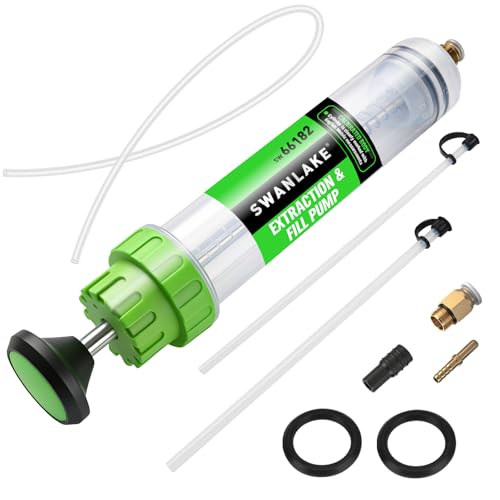
The SWANLAKE 500cc Fluid Extractor & Fill Pump is an essential tool for DIY automotive enthusiasts and professionals alike, streamlining fluid extraction and maintenance tasks. Its strong suction capability, paired with double-seal rubber rings, guarantees efficient removal of engine oil, transmission fluid, and coolant without the mess. You’ll appreciate the 23” silicone hose and two 12” extension tubes, allowing you to reach deep reservoirs easily. The transparent graduated body lets you monitor fluid levels accurately, while the leak-proof metal-threaded nozzle guarantees compatibility with various automotive fluids. Constructed from durable PP material, it’s designed to withstand gasoline, brake fluid, and antifreeze.
Best For: DIY automotive enthusiasts and professionals looking for an efficient tool for fluid extraction and maintenance tasks.
Pros:
- Strong suction capability ensures efficient removal of various automotive fluids without mess.
- Extended reach with silicone hose and extension tubes makes accessing deep reservoirs easy.
- Durable construction resistant to various automotive fluids enhances longevity and reliability.
Cons:
- Limited capacity of 500cc may require multiple extractions for larger vehicles.
- The effectiveness may vary based on the viscosity of the fluid being extracted.
- Some users may find the need for additional accessories for specific tasks.
3L Transmission Fluid Transfer Pump with 12 ATF Adapters
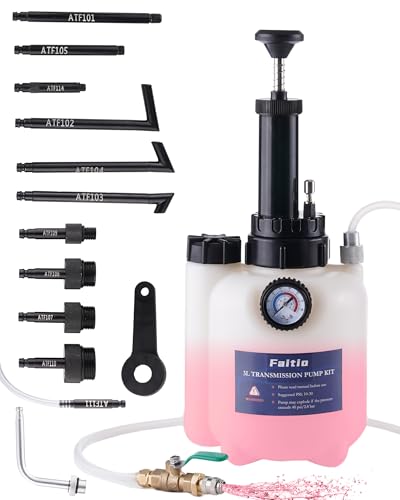
For automotive enthusiasts and professionals, the FAITIO 3L Transmission Fluid Transfer Pump with 12 ATF adapters offers a reliable solution for refilling transmission, differential, gear oil, and power steering fluid. Its built-in pressure gauge guarantees mess-free operation, allowing you to refill quickly and accurately without spills. With compatibility across numerous brands like Ford, BMW, and Toyota, this pump is versatile for various vehicles. Its reinforced construction and compact design make it durable and easy to store or transport. Weighing just 3.94 pounds, it’s perfect for both DIYers and professionals seeking efficient fluid handling solutions.
Best For: Automotive enthusiasts and professionals looking for an efficient and mess-free solution for fluid refilling.
Pros:
- Mess-Free Operation: Built-in pressure gauge allows for precise control, minimizing spills and overfilling.
- Multi-Fluid Compatibility: Works with various automotive fluids, making it versatile for different applications.
- Compact Design: Lightweight and portable, making it easy to store and transport for both DIYers and professionals.
Cons:
- Limited Capacity: At 3L, it may require multiple refills for larger vehicles or extensive fluid changes.
- Specific Adapter Requirement: Users need to ensure they have the right ATF adapter for their vehicle brand.
- Availability Delay: Product availability is set for October 11, 2025, which may not suit immediate needs.
Mityvac MV7300 Pneumatic Vacuum Pump Fluid Evacuator
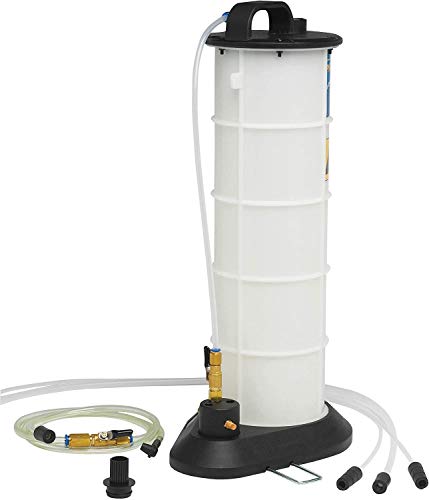
If you’re a DIY mechanic or a professional technician, the Mityvac MV7300 Pneumatic Vacuum Pump Fluid Evacuator is your go-to tool for efficient fluid extraction. This 2.3-gallon venturi vacuum pump utilizes compressed air, making fluid removal quick and easy for various applications, from oil to coolant. Its durable, chemical-resistant polyethylene construction guarantees it withstands harsh liquids, while safety features like an air shut-off valve and overflow prevention protect against spills. With a stable base for reliable use, this evacuator is perfect for garages, shops, and mobile service operations, making your fluid handling tasks smoother and safer.
Best For: DIY mechanics and professional technicians looking for an efficient fluid extraction solution.
Pros:
- Fast fluid extraction suitable for a variety of applications including oil, brake fluid, and coolant.
- Durable construction with chemical-resistant polyethylene for long-lasting performance.
- Safety features like an air shut-off valve and overflow prevention to minimize spills.
Cons:
- Requires compressed air to operate, which may limit use for those without an air compressor.
- The 2.3-gallon capacity may be insufficient for larger jobs or heavy-duty applications.
- Initial setup may require some time to ensure proper connections with air supply.
OEMTOOLS Pneumatic/Manual Fluid Extractor (2.5 Gallon)

Engineers and DIY enthusiasts will appreciate the OEMTOOLS 24938 Pneumatic/Manual Fluid Extractor, designed to simplify fluid extraction tasks. This 2.5-gallon extractor efficiently handles coolant, transmission, and power steering fluids, letting you switch between pneumatic and manual operation. You won’t need to crawl under vehicles or remove drain plugs; it extracts fluids through dipstick tubes for hassle-free maintenance. With an automatic shut-off valve, it prevents spills, enhancing safety and cleanup. The durable, leak-resistant tank, oversized pumping handle, and 41 dipstick hose adapters make it user-friendly, ensuring you can easily access deeper reservoirs in cars, trucks, and equipment.
Best For: Technicians, DIYers, and fleet service operators looking for an efficient way to extract fluids without the hassle of traditional methods.
Pros:
- Dual operation allows for both pneumatic and manual extraction, making it versatile for different garage setups.
- Automatic shut-off valve enhances safety by preventing spills when the tank is full.
- Includes 41 dipstick hose adapters and a 5-foot suction hose for easy access to various fluid reservoirs.
Cons:
- Limited to a 2.5-gallon capacity, which may require frequent emptying for larger jobs.
- Pneumatic operation requires an air supply, which may not be available in all work environments.
- Initial setup may take some time to familiarize with different hose adapters and operation methods.
FOUR UNCLES 3L Transmission Fluid Pump with ATF Adapters

The FOUR UNCLES 3L Transmission Fluid Pump stands out as an ideal choice for DIY automotive enthusiasts seeking a reliable and user-friendly solution for fluid transfer. With its one-handed operation and quick-connect coupler, transferring fluid becomes effortless. You’ll appreciate the included 12 ATF refill adapters, ensuring compatibility with most vehicle transmissions. The pressure gauge allows real-time monitoring, while the quick-release valve prevents over-pressurization. Constructed from premium materials, it boasts durability for frequent use. With a solid 4.5-star rating from customers, this pump proves to be an effective tool for maintaining your vehicle’s performance. Plus, it’s backed by Amazon’s 30-Day Return Guarantee.
Best For: DIY automotive enthusiasts looking for a reliable and user-friendly transmission fluid transfer solution.
Pros:
- Easy one-handed operation for effortless fluid transfer.
- Includes 12 ATF refill adapters for compatibility with most vehicle transmissions.
- Durable construction ensures long-lasting performance even with frequent use.
Cons:
- May not be suitable for professional mechanics requiring heavy-duty equipment.
- Limited to manual operation, which could be less efficient for larger jobs.
- The pressure gauge may require calibration for precise monitoring.
Transmission Fluid Transfer Pump with 12pc ATF Adapters

For automotive enthusiasts and professionals alike, the Transmission Fluid Transfer Pump with 12pc ATF Adapters offers an efficient solution for fluid management. This 3-liter manual refill system quickly extracts fluids using shop air, ensuring high extraction speed while the built-in pressure gauge allows precise flow adjustments. With 12 adapters, it’s versatile enough for various vehicle manufacturers, handling transmission fluid, engine coolant, motor oil, brake fluid, and power steering fluid. The durable design features a flexible nylon hose and a strong reservoir, while the upgraded pressure relief valve guarantees consistent air pressure for peak performance.
Best For: Automotive enthusiasts and professionals looking for an efficient fluid transfer solution.
Pros:
- Versatile: Comes with 12 adapters to accommodate various vehicle manufacturers and fluid types.
- High Efficiency: Quickly extracts and dispenses fluids using shop air for fast operation.
- Durable Design: Made from strong materials with a flexible nylon hose ensuring long-lasting performance.
Cons:
- Manual Operation: Requires manual intervention for refilling, which may not suit all users.
- Air Dependency: Requires shop air, making it less convenient for those without access to compressed air.
- Limited Capacity: The 3-liter capacity may not be sufficient for larger jobs or heavy-duty use.
Factors to Consider When Choosing an Automotive Fluid Handling System
When you’re choosing an automotive fluid handling system, several key factors come into play. You’ll want to evaluate fluid capacity and efficiency, compatibility with your vehicle type, and the operation mechanism. Don’t forget about safety features, durability, and how easy it is to store or transport the system.
Fluid Capacity and Efficiency
Choosing an automotive fluid handling system involves more than just picking a random model; you need to contemplate fluid capacity and efficiency to maximize your workflow. A system with a larger capacity, like a 10-liter model, can greatly enhance your efficiency during oil changes or fluid refills, reducing the need for frequent refills. This is especially beneficial in professional settings or for busy DIYers. Additionally, consider the pump design; manual pumps offer a steady flow, while pneumatic systems speed up fluid extraction. Features like built-in pressure gauges and automatic shut-off mechanisms prevent spills and guarantee accurate delivery. Finally, opt for a compact design to improve portability and storage, allowing quick shifts between various automotive tasks without compromising performance.
Compatibility With Vehicle Types
Compatibility with various vehicle types is essential in selecting an automotive fluid handling system. You’ll want a system that accommodates cars, trucks, and SUVs to cover diverse maintenance needs. Look for options that include multiple adapters, enhancing compatibility with brands like BMW, Audi, Ford, and Honda. It’s also important to take into consideration the specific types of fluids you’ll handle, such as transmission fluid, coolant, or oil, since different vehicles have unique fluid requirements. Evaluate the system’s capacity and design to guarantee it efficiently manages the fluid needs of larger vehicles or those with multiple reservoirs. By taking these factors into account, you can ensure your fluid handling system meets the demands of your vehicle fleet effectively.
Operation Mechanism and Control
Understanding the operation mechanism and control of an automotive fluid handling system is essential for optimizing its use during maintenance tasks. You’ll find options like manual, pneumatic, or electric extraction methods to suit your needs. Many systems feature push-button controls, making fluid extraction and dispensing effortless. With dual control systems and two-way valves, you can easily switch between extracting and dispensing, enhancing your efficiency. Real-time monitoring is critical, so look for built-in pressure gauges that help you track fluid levels and extraction pressures. Additionally, automatic shut-off and overflow prevention systems are essential to prevent spills and overfilling, ensuring a cleaner workspace. Choosing the right operation mechanism can meaningfully impact your maintenance experience.
Safety Features and Durability
When selecting an automotive fluid handling system, it’s imperative to prioritize safety features and durability, as these elements directly impact your efficiency and peace of mind. Look for automatic shut-off valves and overflow prevention systems to prevent spills and guarantee mess-free operation. Durable materials, like chemical-resistant polyethylene and corrosion-resistant components, enhance the system’s longevity, especially under harsh conditions. Incorporating pressure gauges helps you monitor fluid levels accurately, preventing over-pressurization and minimizing accident risks. Additionally, systems with stable bases and ergonomic handles improve user safety and comfort, reducing the likelihood of spills. Regular maintenance and inspections of these safety features will promote peak performance and extend the lifespan of your equipment, fostering a safer working environment.
Portability and Storage Solutions
How can you guarantee your automotive fluid handling system meets your needs for both portability and storage? Start by choosing a lightweight and compact design that’s easy to transport, especially if you’re a DIY enthusiast or mobile mechanic. Look for systems with integrated handles or wheels for effortless maneuvering in garages or service stations. Disassemblable or collapsible designs are ideal, allowing for convenient storage and minimizing space when not in use. Consider the size of the fluid reservoir; smaller units are easier to handle, while larger ones improve efficiency for bigger jobs. Finally, ascertain the materials are durable yet lightweight, enhancing both longevity and portability. Making these choices will streamline your maintenance tasks effectively.
Construction Material and Quality
Choosing the right construction material and quality for your automotive fluid handling system can greatly impact its performance and longevity. Look for chemical-resistant materials like polyethylene or durable polypropylene; these can withstand exposure to various fluids without degrading. High-quality materials enhance durability, ensuring your system endures demanding conditions and frequent use. Features like double-seal rubber rings improve extraction efficiency and prevent leaks, while metal-threaded nozzles provide leak-proof connections for a mess-free experience. Lightweight yet sturdy designs make transportation and storage easy, so you can handle your equipment seamlessly. Finally, prioritize safety features such as automatic shut-off valves and pressure gauges to prevent spills and overfilling, ensuring safe handling of potentially hazardous fluids.
Ease of Use and Maintenance
While evaluating automotive fluid handling systems, ease of use and maintenance should be top priorities to guarantee efficient operation. Look for systems featuring user-friendly options like push-button controls or manual pumps, allowing you to easily manage fluid extraction and dispensing. Clear pressure gauges and flow control valves enhance precision, ensuring efficient fluid transfer without spills. Automatic shut-off valves or overflow prevention mechanisms can eliminate mess and reduce overfilling risks. Lightweight and portable designs make it easier to maneuver and store your system, especially in tight spaces. Finally, choose systems that are easy to clean and maintain, constructed from durable materials that resist corrosion and wear, ensuring longevity and reliability in your automotive applications.
Versatility for Different Fluids
Selecting an automotive fluid handling system that accommodates a variety of fluids is essential for maximizing its usefulness in your maintenance tasks. Verify the system is compatible with oil, coolant, transmission fluid, and brake fluid to handle diverse needs. A system with multiple adapters enhances versatility, allowing you to work with various makes and models without hassle. Look for one that efficiently manages both extraction and dispensing of fluids, so you won’t need to switch equipment frequently. Systems designed for multiple fluids often include specialized components like pressure gauges and flow control valves, verifying precise handling and reducing spills. Finally, prioritize durability and material resistance to withstand exposure to automotive chemicals without degrading over time.