When it comes to automotive diagnostics, choosing the right tool can make all the difference in efficiency and accuracy. In 2025, a range of platforms stands out, each tailored to various user needs, from seasoned mechanics to casual DIYers. With features like live data streaming and extensive vehicle coverage, these tools are designed with performance in mind. But which ones truly deliver on their promises? Let’s explore the top contenders this year.
ANCEL AD310 OBD II Scanner Car Engine Fault Code Reader

If you’re a DIY car enthusiast or just someone who wants to troubleshoot engine issues without breaking the bank, the ANCEL AD310 OBD II Scanner is a standout choice for you. This compact and sturdy device is compatible with vehicles from 1996 onward, making it versatile for many users. With features like CEL Doctor, it quickly identifies check engine light causes and reads live data. Plus, it clears diagnostic trouble codes in seconds. No batteries are required, as it’s powered directly from the OBDII connector. Just grab it, and you’re ready to tackle those engine diagnostics with ease!
Best For: DIY car enthusiasts and individuals seeking an affordable solution for troubleshooting engine issues in OBDII vehicles.
Pros:
- CEL Doctor feature quickly identifies causes of check engine light.
- User-friendly design with clearly labeled buttons and a large display for easy navigation.
- No batteries required, powered directly from the OBDII Data Link Connector for hassle-free use.
Cons:
- Primarily focused on diagnosing emission-related issues, limiting its scope.
- Incompatibility with OBDI vehicles, even with adapters, restricting its use for older models.
- May not read certain unrelated engine fault codes, narrowing its diagnostic capabilities.
FOXWELL Car Scanner NT604 Elite OBD2 Diagnostic Tool

The FOXWELL Car Scanner NT604 Elite OBD2 Diagnostic Tool is perfect for car owners who want a reliable and user-friendly solution for diagnosing their vehicles. This 2025 version comes ready to use with the latest software, scanning key systems like ABS, SRS, engine, and transmission. With its 5-in-1 functionality, you can access live data, built-in DTC library, and even print reports. The AUTOVIN feature quickly retrieves vehicle information, and you won’t have to pay extra for software updates. Plus, its durable design prevents damage, ensuring long-term use. Just remember, it doesn’t support some maintenance functions, so check compatibility first.
Best For: Car owners seeking an efficient and user-friendly diagnostic tool to identify vehicle issues before repairs.
Pros:
- 5-in-1 functionality allows for comprehensive diagnostics across multiple systems.
- AUTOVIN feature enables quick retrieval of vehicle information without extra software fees.
- Durable design with a protective case ensures long-lasting use and prevents damage.
Cons:
- Does not support maintenance functions such as oil reset or battery registration.
- Compatibility may vary by vehicle make, model, and year, requiring verification before purchase.
- Airbag crash/collision data cannot be cleared even with new airbag installation.
GODIAG GT100+ OBDII Breakout Box for Car Diagnostics
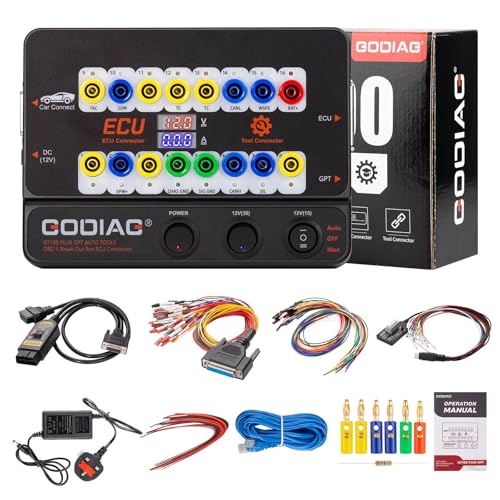
For automotive technicians and DIY enthusiasts seeking a reliable tool for advanced diagnostics, the GODIAG GT100+ OBDII Breakout Box stands out with its ability to support both 24v to 12v voltage conversion and DOIP-ENET communication. This tool excels in ECU connector functionality, CAN protocol detection, and ECU bench testing. You can read and write ECU data without disassembly, minimizing risk during vehicle testing. Its shielded twisted cables resist interference, ensuring stable communication. With LED indicators for communication status and power management features, it maintains vehicle power during battery replacements, preventing data loss and module malfunctions.
Best For: Automotive technicians and DIY enthusiasts looking for a reliable tool for advanced car diagnostics and ECU testing.
Pros:
- Supports 24v to 12v voltage conversion, making it versatile for different vehicles.
- Enables ECU bench testing without disassembly, reducing the risk of data loss.
- Equipped with shielded cables that ensure stable communication by resisting electromagnetic interference.
Cons:
- May be complex for beginners unfamiliar with advanced automotive diagnostics.
- Requires knowledge of OBDII protocols for optimal use.
- The initial investment might be higher compared to basic diagnostic tools.
FOXWELL NT301 OBD2 Scanner Code Reader Tool

Equipped with live data functionality, the FOXWELL NT301 OBD2 Scanner Code Reader Tool is perfect for both home mechanics and professional auto shops. You’ll appreciate its ability to read fault codes and access emissions readiness status, making it a reliable choice for diagnostics. With features like I/M readiness hotkeys and LED indicators, checking your vehicle’s status becomes straightforward. Plus, it’s compatible with a wide range of vehicles from 1996 US-based to 2000 EU-based models. The 2.8-inch color screen guarantees clear visibility, while free lifetime updates keep your tool current, enhancing your overall diagnostic experience.
Best For: The FOXWELL NT301 OBD2 Scanner is best for home mechanics and professional auto shops seeking an efficient and reliable diagnostic tool for various vehicles.
Pros:
- Easy to use with no updates required before operation.
- Compatible with a wide range of vehicles, enhancing versatility.
- Live data functionality provides accurate error code reading and monitoring.
Cons:
- Limited to OBD2 compatible vehicles, which may exclude some older models.
- May require the ignition to be in the “on” state for code reading.
- The 2.8-inch screen size may be considered small for some users.
ANCEL AD410 Enhanced OBD2 Scanner for Vehicle Code Reading

If you’re a DIY mechanic or car enthusiast looking for an efficient way to diagnose vehicle issues, the ANCEL AD410 Enhanced OBD2 Scanner stands out with its ability to read and clear emissions-related fault codes quickly. Compatible with all 16PIN vehicles, it supports various protocols, making it versatile for different models. With over 42,000 built-in DTC lookups, you’ll easily identify faults. The 2.4 TFT LCD display guarantees clear results, while the user-friendly design simplifies operation. Plus, it performs advanced diagnostics like O2 sensor tests to boost fuel efficiency. Overall, it’s a reliable tool for every car enthusiast.
Best For: DIY mechanics and car enthusiasts seeking an efficient and user-friendly tool for diagnosing vehicle issues.
Pros:
- Quickly reads and clears emissions-related fault codes with over 42,000 built-in DTC lookups for easy fault identification.
- User-friendly design with a clear 2.4 TFT LCD display and simple operation process, making it accessible for all skill levels.
- Advanced diagnostics capabilities, including O2 sensor and EVAP system testing, to improve fuel efficiency and reduce emissions.
Cons:
- Fault codes can only be cleared after resolving the underlying issue, limiting its functionality for quick fixes.
- No reset function available, which may require additional tools for certain maintenance tasks.
- Update compatibility limited to Windows, as it does not support Mac systems for upgrades.
Innova 5210 OBD2 Scanner & Engine Code Reader

The Innova 5210 OBD2 Scanner & Engine Code Reader stands out as an essential tool for DIY mechanics and car enthusiasts alike. It offers a range of functions, including a battery tester, live data access, and oil reset capabilities. Compatible with most US, Asian, and European vehicles from 1996 onward, it reads and clears check engine and ABS codes. With access to OBD2 live data like RPM and engine temperature, plus built-in maintenance features, you’ll be well-equipped for diagnostics. The free RepairSolutions2 app provides verified fixes and repair guidance, ensuring you tackle any issue confidently without hidden fees.
Best For: DIY mechanics and car enthusiasts looking for a versatile and user-friendly diagnostic tool.
Pros:
- Comprehensive Compatibility: Works with most US, Asian, and European vehicles from 1996 onward.
- User-Friendly App Integration: The free RepairSolutions2 app offers verified fixes and step-by-step repair guidance.
- Multiple Diagnostic Functions: Includes features like battery testing, live data access, and maintenance light resets.
Cons:
- Coverage Variability: Diagnostic features may vary across different makes, models, and years.
- Limited Advanced Features: May not include advanced functions available in higher-end scanners.
- No Real-Time Support: Lacks live support or direct assistance during troubleshooting.
ANCEL DS100 OBD2 Scanner with 7 Reset Functions

For car enthusiasts and DIY mechanics seeking a reliable and versatile tool, the ANCEL DS100 OBD2 Scanner stands out with its seven reset functions. This scanner excels in diagnostics, covering Engine, Transmission, ABS, and SRS systems, making it ideal for identifying issues like misfires and ABS faults. Its user-friendly features include auto VIN detection and a high-resolution touchscreen. You’ll appreciate the organized diagnostic reports that can be easily shared via Bluetooth or email. Plus, enjoy lifetime free updates for vehicle coverage without subscription fees, ensuring your tool remains up-to-date and effective for all your automotive needs.
Best For: Car enthusiasts and DIY mechanics looking for a reliable and versatile diagnostic tool to troubleshoot vehicle issues.
Pros:
- Comprehensive Diagnostics: Covers multiple systems including Engine, Transmission, ABS, and SRS for thorough vehicle analysis.
- User-Friendly Features: Auto VIN detection and a high-resolution touchscreen enhance ease of use for all skill levels.
- Lifetime Free Updates: Ensures the scanner remains effective with the latest vehicle coverage and diagnostic features without extra costs.
Cons:
- Compatibility Limitations: Functions may vary based on vehicle make, model, and system configuration, potentially limiting effectiveness for some users.
- Basic Functions for Advanced Users: While it offers core diagnostic capabilities, professionals may find it lacking for more complex diagnostic needs compared to higher-end models.
- Limited Bluetooth Features: While it allows sharing reports via Bluetooth, it does not support full Bluetooth diagnostics, which may be a drawback for some users.
Autel MaxiCOM MK808Z OBD2 Scanner

With its impressive diagnostic capabilities and user-friendly features, the Autel MaxiCOM MK808Z OBD2 Scanner stands out as the perfect choice for home mechanics and aspiring repair business owners. This upgraded model boasts a powerful Rockchip RK3566 4-core CPU, delivering 5X faster service speed than its predecessors. You can diagnose over 150 vehicle brands, read and clear codes, and perform essential tests like EVAP and fuel trim resets. Plus, with 28+ service functions, including ABS bleed and oil reset, it’s incredibly versatile. Enjoy one-year free updates for new features, ensuring your scanner remains cutting-edge and reliable.
Best For: Home mechanics and aspiring repair business owners looking for a reliable and efficient OBD2 scanner.
Pros:
- Fast Performance: Equipped with a Rockchip RK3566 4-core CPU, providing 5X faster service speed compared to older models.
- Comprehensive Diagnostics: Capable of diagnosing over 150 vehicle brands and performing various essential tests and service functions.
- User-Friendly Features: Includes an Auto VIN feature and Wi-Fi printing capability for detailed diagnostic reports.
Cons:
- Limited Advanced Features: Some advanced functionalities may not be available for all vehicle brands.
- One-Year Update Limitation: After the first year, users may need to pay for continued software updates.
- Learning Curve: New users may require time to familiarize themselves with the extensive features and functions.
FOXWELL NT301 Plus OBD2 Scanner Battery Tester

Equipped with a 2-in-1 design, the FOXWELL NT301 Plus OBD2 Scanner Battery Tester is a perfect choice for DIY mechanics and car enthusiasts. It’s compatible with vehicles from 1996 and includes a 2.8-inch color display for clear readings. You can quickly read DTCs, reset the Check Engine Light, and monitor live data like RPM and coolant temperature. For battery testing, it measures State of Health and Cold Cranking Amps with impressive accuracy, even in cold conditions. While it primarily focuses on engine diagnostics, its user-friendly interface makes it great for home or roadside use, backed by FOXWELL’s reliable updates.
Best For: DIY mechanics and car enthusiasts looking for a reliable tool for engine diagnostics and battery testing.
Pros:
- 2-in-1 functionality for both OBD2 scanning and battery testing, making it versatile for various needs.
- User-friendly design with a 2.8-inch color display for clear and easy reading of data.
- High accuracy in battery testing, even in cold conditions, providing reliable battery health insights.
Cons:
- Limited to engine and 12V battery diagnostics, not covering ABS, SRS, or other advanced systems.
- Does not support non-OBDII protocols and certain vehicle models, which may restrict usage for some users.
- Software updates are Windows-only, potentially inconvenient for users with other operating systems.
BluSon YM319 OBD2 Scanner Diagnostic Tool

The BluSon YM319 OBD2 Scanner Diagnostic Tool stands out as an essential companion for car enthusiasts and everyday drivers alike. With its built-in battery tester, it reads and clears engine fault codes, monitors performance, and supports advanced diagnostics like oxygen sensor testing. You’ll appreciate the extensive database of over 63,000 fault codes for accurate diagnostics. The user-friendly 2.4 HD color screen and customizable shortcut keys enhance your experience. This scanner supports all OBDII protocols, making it compatible with most vehicles since 1996, and it even offers 13 language options. Plus, dedicated customer support guarantees you won’t navigate issues alone.
Best For: The BluSon YM319 OBD2 Scanner is best for car enthusiasts and everyday drivers seeking a reliable tool for engine diagnostics and performance monitoring.
Pros:
- Extensive database of over 63,000 fault codes for precise diagnostics.
- User-friendly design with a 2.4 HD color screen and customizable shortcut keys for easy operation.
- Wide vehicle compatibility supporting all OBDII protocols for most vehicles since 1996 and 13 language options.
Cons:
- Limited functionality as it only reads engine fault codes and does not support ABS, SRS, or transmission systems.
- No advanced features compared to higher-end models, which may limit some users’ needs.
- Dependency on battery for operation, requiring charging or battery checks to ensure usability.
Factors to Consider When Choosing an Automotive Diagnostic Platform
When you’re selecting an automotive diagnostic platform, you’ll want to take into account several key factors. Think about compatibility with various vehicle models and the diagnostic functionality it offers. Additionally, the user interface’s ease of use, portability, and live data monitoring capabilities are essential for effective diagnostics.
Compatibility With Vehicle Models
Choosing an automotive diagnostic platform that’s compatible with your vehicle models is vital for effective maintenance and repairs. Confirm the tool adheres to OBDII protocols, particularly for vehicles made from 1996 onwards in the U.S., 2000 for European models, and 2005 for Asian cars. It’s essential to verify that the diagnostic tool supports your specific make and model, as compatibility can vary even within the same brand. Some tools may only read emissions codes, while others can access systems like ABS and SRS. Look for platforms that support multiple protocols—like KWP2000 or CAN—to enhance versatility across different brands. Finally, check for manufacturer updates to guarantee ongoing compatibility with newer models.
Diagnostic Functionality Offered
Understanding diagnostic functionality is key to selecting an effective automotive diagnostic platform. You’ll want a tool that can read and clear diagnostic trouble codes (DTCs) across various systems like the engine, ABS, SRS, and transmission. This guarantees thorough vehicle assessments. Look for advanced features such as live data streaming, freeze frame data, and I/M readiness status, which help diagnose intermittent issues and prepare for emissions tests. A built-in DTC library can boost efficiency by offering immediate definitions for fault codes. Additionally, some platforms provide maintenance functions like oil reset and battery matching, which are crucial for routine care. Confirm compatibility with a wide range of vehicles, especially support for OBDII protocols, to maximize your diagnostic capabilities.
User Interface Ease
How intuitive is the user interface of your automotive diagnostic platform? A user-friendly interface features clearly labeled buttons and a large display, making navigation and reading diagnostic results straightforward. Touchscreen capabilities enhance interaction, allowing you to access functions and data easily without fumbling with physical buttons. An Auto VIN feature can streamline your process by automatically retrieving vehicle information, minimizing manual entry errors. If you’re new to diagnostics, built-in help menus or tooltips can guide you through various functions, making the device easier to operate. Additionally, customizable shortcut keys help you quickly access frequently used features, boosting your efficiency and speed during diagnostics. Overall, a well-designed user interface can markedly improve your experience.
Portability and Design
A user-friendly interface sets the stage for an effective diagnostic experience, but portability and design are equally important when selecting an automotive diagnostic platform. Consider the weight and dimensions of the device; a compact, lightweight design makes it easier to transport and use wherever you need. Look for a scanner with durable construction and a flexible cable to guarantee it withstands frequent handling. A user-friendly layout with clearly labeled buttons and a large display can simplify navigation and speed up your analysis. Additionally, choose a model that powers directly from the vehicle’s OBD2 port, eliminating the hassle of extra batteries. Some devices even include protective cases, enhancing portability and preventing damage during transport.
Live Data Monitoring
Live data monitoring is an essential feature in modern automotive diagnostic platforms, providing you with real-time insights into engine performance. This capability allows you to observe various engine parameters, such as RPM, coolant temperature, and fuel trims, enhancing your diagnostic accuracy. By graphing live data, you can identify trends and spot intermittent issues that static readings may miss. Many tools let you log live data for later analysis, facilitating thorough evaluations of vehicle performance over time. Live data streaming helps pinpoint the root causes of faults by correlating operational variables with specific diagnostic trouble codes (DTCs). Additionally, access to this data can prepare vehicles for emissions tests, confirming that all systems function correctly before inspection.
Maintenance Function Availability
Real-time insights from live data monitoring set the stage for the importance of maintenance function availability in automotive diagnostic platforms. When you’re selecting a platform, consider essential functions like oil reset, battery registration, and ABS bleeding. These features can greatly enhance your vehicle servicing experience, saving you time and boosting efficiency, whether you’re a professional mechanic or a DIY enthusiast. It’s vital to ascertain that the tool supports maintenance functions specific to your vehicle’s make and model, as compatibility varies widely. Look for platforms with built-in capabilities for real-time monitoring and reporting of maintenance tasks. A thorough diagnostic tool with robust maintenance functions can help prevent future issues by enabling timely resets and adjustments after repairs.
Software Update Policies
When choosing an automotive diagnostic platform, understanding the software update policies can considerably impact your experience. Some tools offer free lifetime updates, while others charge fees for ongoing access to the latest features and vehicle coverage. You’ll want to check if updates are automatic or require your initiation, as manual updates can disrupt usability. The frequency of these updates is also essential; more frequent updates mean quicker adaptation to new vehicle models and troubleshooting protocols. Consider compatibility with your operating system, too—some tools only support updates on specific platforms like Windows. Finally, understanding what each update includes, such as new vehicle models or fixes for existing issues, will greatly influence your long-term satisfaction with the tool.
Price and Value Comparison
Choosing the right automotive diagnostic platform involves more than just the initial price tag; it’s essential to evaluate the value you’ll get from its features and capabilities. Start by comparing the purchase price against the functionalities offered. Higher-priced models often deliver advanced features like multi-system diagnostics and live data streaming. Consider long-term value, too; platforms that include free lifetime software updates can enhance functionality without extra costs. Check the diagnostic coverage—some may only read basic OBDII codes, while others cover systems like ABS and SRS. Don’t overlook warranty and customer support options; a solid warranty and responsive support add significant value. Finally, read user reviews to assess reliability and effectiveness, ensuring you make a worthwhile investment.